


Ever had to build a deck to justify a deck?
Three meetings. One spreadsheet. Still no budget.
Meanwhile the ads team gets topped up every month because a pixel fired on a Tuesday. And the person who makes the brand look like something people actually want gets told to just whip something up in Canva.
So why is creative still the first thing that gets cut?
-Abdel Khalil, Head of Colouring In
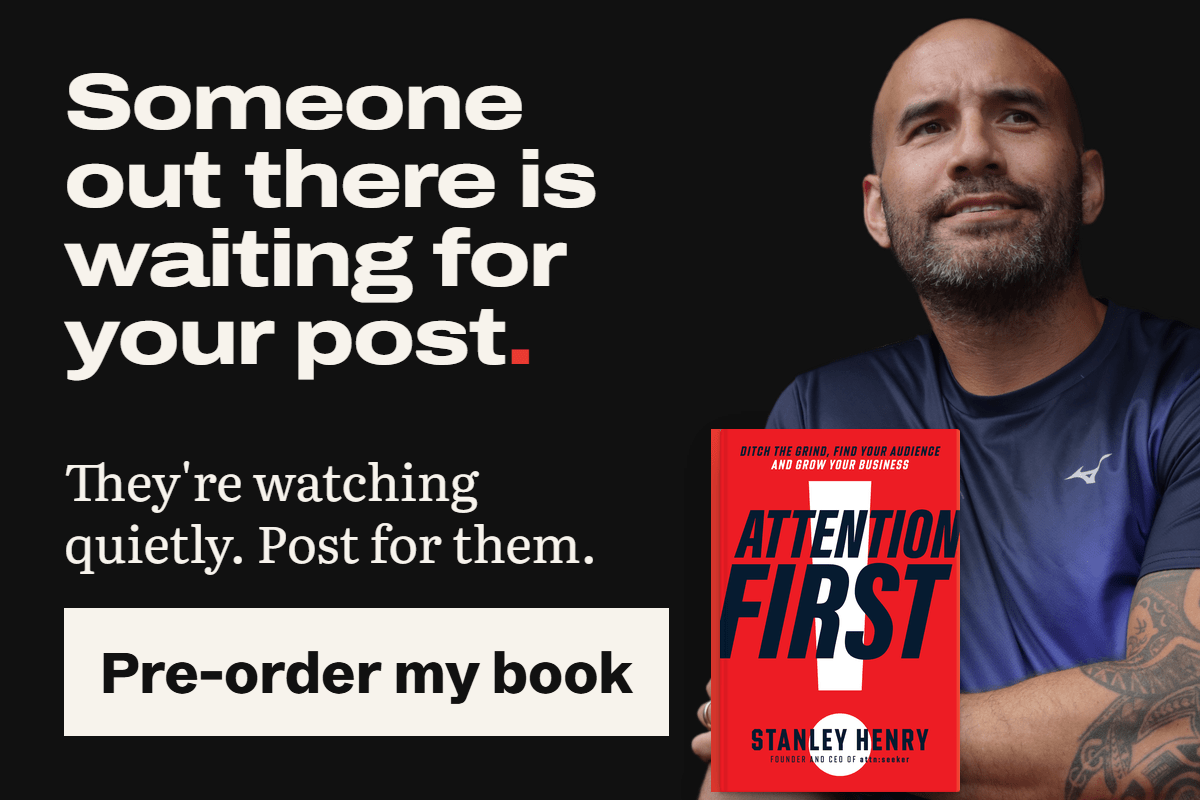
The Attention Seeker started at my kitchen table with one post. Posting changed everything for me. It can for you too. This book is how I'd do it in your shoes. Pre-order before 8 Jan 2027, send me the receipt, and get a free seat at my webinar, How to win on social media in 2027. Usually 189. Live 13, 20 or 27 Jan, or 10 Feb, 3pm NZDT.
Why Are We Still Treating Creative Like "Fluff"?

I had coffee with a friend over the weekend, and within ten minutes, we were balls deep into a classic (traumatic) industry venting session. She works in-house doing marketing for a brand I will graciously refrain from naming, and the story was depressingly familiar. Her boss has been grossly underpaying her for months, yet simultaneously expects miracles. Worse, every single time she tries to pitch a proper campaign or ask for a realistic production budget, she has to fight tooth and nail to justify why it matters.
We both laughed, mostly because if you don't laugh, you’ll start crying into your oat latte, and let out a collective, exhausted: "Welp, welcome to the world of being a creative in marketing."
And then on my walk home, I kind of realised how genuinely fucked up that dynamic still is.
How are we sitting in late 2026, watching legacy businesses crumble overnight due to cultural irrelevance, and corporate leadership still treats brand creative like an optional decorative garnish? Why is the person responsible for making a company look, sound, and feel like something humans actually want to buy from still treated like part of the "fluff"?
You can’t afford to neglect brand. So why is it ok to neglect your marketing creatives?
The Spreadsheet Delusion
The root of this hostility comes down to a severe obsession with easily tracked attribution. Modern corporate leadership loves a tidy dashboard.
They love performance marketing, paid search, and automated email flows because you can put one dollar into a machine, watch a conversion pixel fire, and point to a neat spreadsheet that proves return on investment by Friday afternoon.
Brand creative, by contrast, is messy. You cannot neatly attribute a sudden surge in organic word-of-mouth or a spike in customer loyalty to a single, beautifully art-directed video or a sharp piece of copywriting.
Because the financial return on taste and storytelling operates on a delayed, compounding timeline, spreadsheet-obsessed executives routinely dismiss it as a frivolous cost centre.
They view the creative marketer as the "colouring-in department", someone brought in at the very end of the product pipeline to make things look pretty, rather than a core strategic driver of revenue.
Taste Is the Only Moat Left
Here is the massive blind spot those underpaying, budget-hoarding bosses are completely missing: performance marketing without brand equity is a slow-motion suicide pact.
When every single competitor in your category has access to the exact same Meta ad targeting, Shopify templates, and generative AI tools, paid acquisition becomes an expensive, commodified auction. Customer acquisition costs skyrocket because nobody knows who you are, and nobody gives a shit.
In a saturated market, creative direction, distinct voice, and cultural intuition are the only defensible moats a business actually has left. They are the exact variables that make a consumer choose your product over a cheaper, identical alternative on Amazon.
When a founder refuses to fund creative execution or underpays the very person responsible for translating their business into human culture, they aren't being fiscally responsible. They are starving their own growth engine. You cannot automate taste, and you cannot spreadsheet your way into cultural relevance. If you treat your creative team like disposable overhead, you will inevitably end up with a disposable brand.
And baby, serves you right.
The YAP Takeaway
Neglecting brand creative in 2026 is not going to save your pretty pennies. Because it’s a strategic liability.
If you are a founder or executive constantly demanding receipts before approving a single dollar for storytelling, design, or cultural positioning, you are optimising your business straight into irrelevance.
Performance ads might capture existing demand, but creative is what manufactures that demand in the first place. Pay your creatives what they are actually worth, give them the budget to build something memorable, and stop treating the very people keeping your brand alive like an afterthought.
Thank you for coming to my TED Talk.
-Sophie Randell, Writer
Not going viral yet?
We get it. Creating content that does numbers is harder than it looks. But doing those big numbers is the fastest way to grow your brand. So if you’re tired of throwing sh*t at the wall and seeing what sticks, you’re in luck. Because making our clients go viral is kinda what we do every single day.
